Who Developed Linux? The Kernel, GNU and Torvalds
Who developed Linux? See how Linus Torvalds, GNU tools, and thousands of contributors shaped the kernel, distros, and desktops you use today.
tl;dr the short answer
Linus Torvalds developed the Linux kernel, the core software that manages a computer’s hardware and running programs. The complete systems commonly called Linux also rely on GNU tools, while thousands of contributors have improved the kernel and surrounding software over time. In practice, Torvalds began the project, but the Linux systems people use today are a shared effort packaged into distributions and paired with desktop environments.
Ask a few Linux users who developed Linux and you’ll hear different answers, since the name covers more than one project. Think of a car: one team designs the engine, another builds the transmission, and a third handles the seats and stereo.
The kernel is the core layer that talks to your hardware and manages what runs, and in strict terms, that’s what Linux is.
Linus Torvalds started that kernel, but the GNU project supplied much of the tooling around it, and thousands of later contributors have shaped the kernel since.
In this post, we’ll separate those pieces, then show how the kernel reaches the distros and desktop environments you run every day.
Linus Torvalds, the Person Who Developed Linux
The short answer is one person, but the full picture has more layers than that.
What Torvalds built and still directs
Linus Torvalds was a Finnish student when he created the kernel that became Linux. A kernel is the core layer of an operating system, the part that manages your hardware and runs your programs.
He has been the lead developer since 1991, and he still has the final say on code changes.
Think of a student running a distro on a ten-year-old ThinkPad. When an update finally makes the Wi-Fi card work, the driver change behind it answers to that same final say.
Torvalds also created Git, the version control tool many developers use to track changes to code.
Kernel alone versus the full system
Torvalds wrote the kernel, not the whole system. A kernel on its own can’t give you a usable desktop. The GNU tools fill in the rest: the shell, the compiler, and everyday utilities.
That split is why the naming debate exists. Some people, including supporters of the GNU project, argue the full system should be called GNU/Linux. Others just say Linux, and you’ll see both names in the wild.
Thousands of later contributors have sent code into the kernel and the tools around it. For example, a volunteer fixes a sound driver bug, and a reader on an old laptop gets working speakers after the next update.
Neither one wrote the kernel, but both helped build the system in front of you. One name starts the story, but thousands keep it moving.
How Torvalds’ Early Life Led to Linux
Linus Torvalds’ path to Linux ran through a home computer, Unix at university, and a teaching system that left him wanting more.
How old was Linus when he made Linux?
Linus was 21 when he made Linux in 1991. He was born in Helsinki in December 1969, so he turned 21 in December 1990 and stayed 21 through most of 1991. Here’s the rest of his early life:
- Home life: he grew up in a Swedish-speaking Finnish family
- Studies: the University of Helsinki, from 1988
- Service: navy officer training service
Learning to program at a young age
At age 11, Linus started programming on a VIC-20, a home computer. He began with BASIC, a beginner-friendly language, then moved on to machine code, the raw instructions a processor runs directly. Later he wrote games and tools for the Sinclair QL.
Think of a Hyprland user who tweaks a Waybar script from a forum until the battery readout is right. That’s the same hands-on habit that got Linus typing programs into a VIC-20.
Learning to code is less about memorizing commands and more about changing things until they work. The lesson sticks: if you can read it, you can change it.
Finding Unix, then MINIX, at university
In 1990, at university, Linus got hands-on with Unix, an operating system that manages a computer’s hardware and programs. In January 1991 he bought a 386 personal computer (PC), which gave him a machine to experiment on.
Then came MINIX, Tanenbaum’s system, which was tied to his textbook.
MINIX had limits, and Linus grew dissatisfied with them. That frustration pushed him to write his own kernel, the core layer that talks to your hardware. That’s where Linux begins.
How Early Linux Came Together
Linux didn’t arrive fully formed, so we’ll look at its early years: a run of small, public decisions, a name its author didn’t prefer, and a sharp debate over how a kernel (the core layer that manages your hardware) should be built.
Announcing the first release in 1991
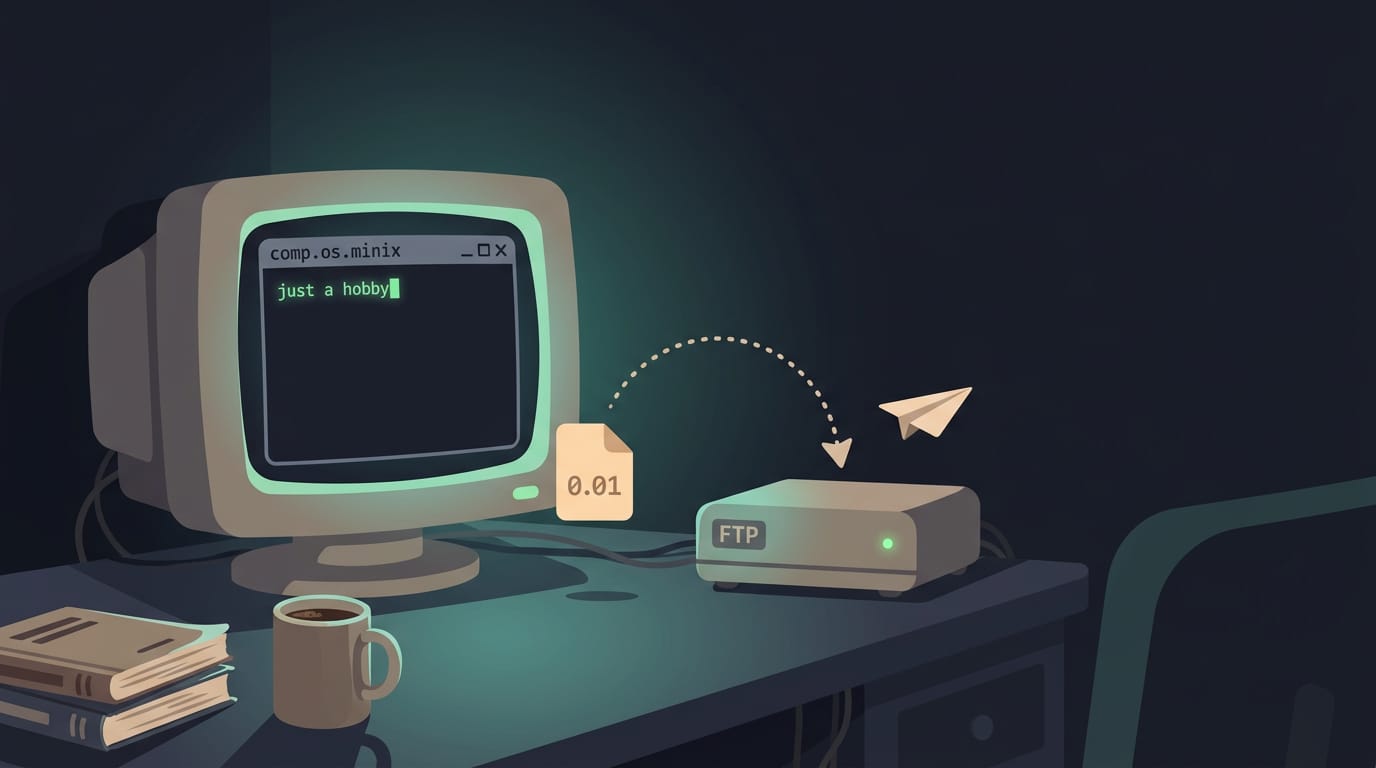
In August 1991, Linus Torvalds posted to the comp.os.minix newsgroup, an online discussion board, and called his project “just a hobby.” That’s about as modest as an operating system announcement gets.
He then uploaded version 0.01 to an FTP (File Transfer Protocol) server so others could download it. Within weeks, a working prototype existed. Not exactly a grand launch.
How the name Linux stuck
Torvalds’ preferred name was Freax, but the name that stuck came from a directory listing. Ari Lemmke named the directory on the FTP server Linux, and the label took hold. Today, that name sits on every distro (short for distribution) you might install.
Major releases from 1.0 to 6.1
Version 1.0 arrived in March 1994, and version 2.0 followed in 1996. Later releases continued the numbering from 3.0 up through 6.0. Then, in 6.1, the kernel accepted Rust, a programming language designed to prevent many common memory bugs.
Think of a tinkerer who types uname -r in a terminal to see which kernel they’re running. That number is a point on this timeline, and it hints at what hardware support they can expect. Quite a run for a hobby project.
The famous design clash with Tanenbaum
Tanenbaum’s “Linux is obsolete” post sparked one of the most famous debates in open-source history. At its heart was the difference between a monolithic kernel and a microkernel.
A monolithic kernel runs most core services together in one large block of code, while a microkernel keeps only the essentials and pushes the rest out. Tanenbaum favored the microkernel, while Linux went the monolithic way.
Portability was the other front. Tanenbaum argued that a kernel tightly built around one family of processors is harder to move to other hardware. Heated, public, and permanently on the record.
How Licensing and GNU Shaped Open Source
The kernel doesn’t ship alone. Its license and the GNU tools around it decided who could use, change, and contribute to Linux.
Why the kernel moved to GPLv2
The kernel’s original license banned commercial use. Torvalds later switched Linux to the GNU General Public License (GPL), version 2, a move shaped by Stallman’s influence.
The payoff was openness: anyone could read, change, and share the code, so outside contributors could join in.
Think of a student who finds a bug in the Wi-Fi driver on a ten-year-old ThinkPad. They can patch it and send the fix back, so the next person with that laptop isn’t stuck.
Early contributors and the distributions (distros) that packaged Linux built on that openness too. The GPL didn’t just let people use Linux; it let them improve it.
What the GNU Project contributed
Stallman’s GNU Project began in 1983, and its tools filled much of the rest of the system:
- GCC: the GNU Compiler Collection, which builds programs, including the kernel.
- bash: the GNU shell where you type commands.
- glibc: the GNU C library and its tools that programs rely on.
A kernel alone isn’t a usable desktop. The kernel and GNU tools were built together into one complete system, which is why the two are so often discussed side by side.
Sticking with GPLv2 and free software ideals
Torvalds rejected GPLv3, the later version of the license, over concerns about hardware signing, which locks a device to software its maker approves. The kernel remains GPLv2 only.
At its heart, the idea is simple: software should be free. That’s about freedom more than price, meaning you can:
- run
- study
- change
- share it
Nobody has to unlock it for you.
How Many People Build the Kernel
Linux isn’t a one-person project, and the kernel (the core that talks to your hardware) proves it. Here’s where Linus Torvalds fits in.
Patches, maintainers and the merge window
Changes usually arrive as patches, small sets of code edits sent by email. They pass through maintainers, who each own one part of the kernel, like a driver.
A Tale of Four Kernels reports thousands of developers sending patches to about 560 subsystem maintainers.
From there, changes move up the chain during the merge window, a set period when accepted code gets pulled into the main tree. Torvalds mostly merges code rather than writing it. Nothing skips the line.
Think of a Debian user whose Wi-Fi card only works after a driver fix. That patch travels from a maintainer’s inbox, through the merge window, and into a kernel Debian ships, and the card finally works.
Torvalds’ small slice of the code
Torvalds created Linux in 1991, and it has since drawn many developers and companies, according to a kernel security research paper. His own code is only about 2% of the kernel.
The scale shows up in a Linux Foundation annual kernel report, as covered by MC Press: roughly 15,600 developers from more than 1,400 companies have contributed since the adoption of Git made detailed tracking possible.
We don’t have a reliable explanation of why Torvalds dislikes C++, so we won’t guess at his reasons. For his own words, look for his public statements on the topic.
Essays that shaped open source thinking
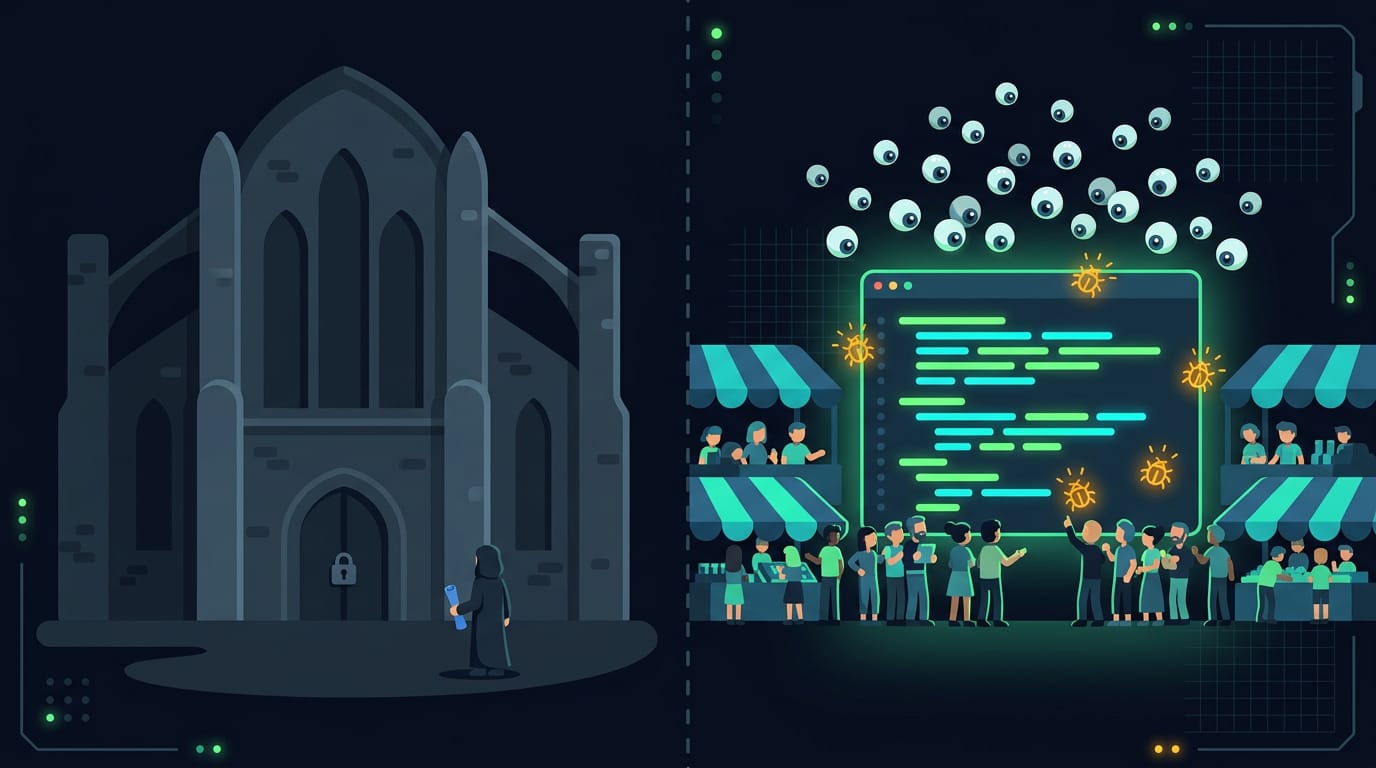
Two ideas help explain how the kernel gets built. The Cathedral and the Bazaar contrasts a carefully planned, closed style (the cathedral) with an open, crowded one (the bazaar).
The many eyeballs idea adds that when enough people look at code, problems tend to surface faster. Kernel development looks more like the bazaar.
How Widely Linux Is Used Today
Linux quietly runs much of the world’s computing, but it’s still a small slice of the desktop.
Running servers, phones and supercomputers
A study of a high-performance computing (HPC) cluster notes that Linux is the most adopted OS on the TOP500 list of the world’s most powerful supercomputers.
XDA Developers reports that all 500 systems on that list have run Linux since November 2017, and even Microsoft’s supercomputers do.
Android is built on the Linux kernel, the core layer that manages your hardware, so your phone runs Linux too. Most web servers and cloud platforms run it as well, and corporate backing from companies like IBM adds serious weight.
As for Bill Gates, our sources don’t include a verified view from him, so we won’t guess.
Distros and why desktops still lag
Linux comes in distributions (distros), which bundle the kernel with tools, and there are hundreds of them. Desktop share stays small.
According to StatisticsGlobal, Linux averaged 4.79% of desktop operating system market share worldwide over the 12 months to September 2026, up from 4.31% a year earlier. Windows comes preinstalled on most new PCs, which is a real barrier to switching.
Valve’s Steam Deck shows real progress for Linux gaming. Think of a student who puts a lightweight distro on a ten-year-old ThinkPad and gets a snappy machine back.
The kernel handles your hardware, while a desktop environment supplies the menus and panels you see. A window manager such as Hyprland sits atop the kernel too.
Customizing is less about which kernel you run and more about which layers sit on top. That’s the part you get to shape.
Git and Torvalds’ Other Projects
Torvalds didn’t stop at the kernel. He also gave us Git, the tool you’ll likely type into a terminal more than any other, plus two smaller projects worth knowing about.
How Git replaced BitKeeper in 2005
Git started in April 2005 as a replacement for BitKeeper, a version control tool, after its licence was withdrawn. The new design is distributed, fast, and corruption-safe, so your history stays intact and everyday commands stay quick.
That lets you use Git all day instead of babysitting it.
Think of a Linux user who keeps their config files, or dotfiles, in a Git repository. After a fresh install, one clone brings back their whole desktop setup, from the status bar to the terminal colours, and the desktop looks like their own again.
Git is now the most widely used version control system. As the research paper Purposes, concepts, misfits, and a redesign of git puts it, Git is a widely used system that’s “powerful but complicated.”
Who took over Git and how it spread
Junio Hamano became Git’s maintainer, the person who oversees the project. GitHub, a website for hosting Git projects online, was built around it.
If you’ve ever pulled a bar theme from GitHub to try on your own desktop, you’ve used the tool Torvalds built.
Dive logging and static analysis tools
Subsurface is dive logging software for recording scuba dives. Picture a diver with a Linux laptop keeping every logbook entry in one place. Sparse is a static analysis tool, meaning it checks code for problems without running it.
Git gets the spotlight. These two deserve a look too.
Torvalds’ Jobs and Organizational Ties
Torvalds has worked for a few employers and had several organizations back his work. Knowing who they were makes the rest of his story easier to follow, so let’s walk through them.
Employers and sponsors over the years
- Transmeta, 1997 to 2003. Torvalds worked at Transmeta during these years.
- Open Source Development Labs. Torvalds was also tied to this group.
- Linux Foundation sponsorship. The Linux Foundation has sponsored his work.
- Move to Oregon. Torvalds later moved to Oregon.
Here’s why this matters on your desktop: the kernel’s driver support decides which hardware works out of the box. Think of a laptop owner whose Wi-Fi card starts working after a routine update, because the kernel underneath gained support for it.
No driver hunt, no forum threads, just a connection that works.
Why isn’t Linus Torvalds a billionaire?
Torvalds did receive stock options tied to Red Hat and VA Linux, and Steve Jobs made him an offer to join Apple. Those are the first places to look when you ask about wealth.
Put simply, Linux was released as free software, so the kernel itself never became a product he could sell. The money came from jobs and stock, not from selling the kernel. Free code doesn’t send a royalty check.
Family, citizenship and hobbies
He’s married to Tove Torvalds and has three daughters. He became a U.S. citizen in 2010. Outside of computing, his hobby is scuba diving, a reminder that the person behind the kernel has a life away from the terminal.
The Linux Name and Its Mascot
A kernel needs a name people can trust, and it needs a face people remember. Here’s how Linux ended up with both.
How the Linux trademark was protected
Popularity doesn’t protect a name. Ownership does, and Linux’s name had a rocky start on that front. The early history includes a royalty dispute involving Della Croce.
The trademark was assigned to Torvalds in 1997, so the name ended up with the person who started the kernel.
Today, the Linux Mark Institute monitors how the trademark is used. Picture a Hyprland user on a fresh install who spots Linux in the boot messages and wants to know whose project they’re looking at.
The name points back to one kernel, and that’s the project worth crediting.
Tux the penguin and who drew him
A penguin was chosen as Linux’s mascot, and he goes by Tux. The name is something you read in a boot log, but the penguin is something you recognize at a glance. He’s hard to miss.
The familiar image of Tux was drawn by Larry Ewing, so that penguin has a specific artist behind him.
Think of a student running Linux on a ten-year-old ThinkPad who puts Tux on the login screen. It’s a small touch, and it makes an old laptop feel like a machine that’s really theirs.
Honors and Awards Torvalds Has Received
Linus Torvalds has picked up a fair number of honors over the years, from a technology prize to an asteroid with his name on it. Here’s a quick tour, grouped by the kind of recognition each one represents.
Top prizes, halls of fame and an asteroid
Start with the 2012 Millennium Technology Prize, followed by the 2014 IEEE Computer Pioneer Award from the Institute of Electrical and Electronics Engineers.
Torvalds is also in the Internet Hall of Fame, and an asteroid carries his name. That’s quite a shelf.
Consider a Fedora user at a local meetup who gets asked who actually built the kernel, the core layer that talks to your hardware.
Naming a prize or the asteroid makes a quick icebreaker, and from there they can explain how that kernel connects to the distribution and desktop environment they run.
Where Torvalds appears on influence lists
Torvalds has also appeared on Time’s influential lists and on innovator lists for people under 35. These lists measure visibility rather than authorship. They show how far a name has traveled, not who wrote which part of the code.
For you, the takeaway is that one famous name sits on top of a very large shared effort.
Blunt Style and the Controversies Around It
Torvalds’ direct feedback is well known, and it has fueled several public disputes. Some are about how people treat each other. Others are about the tools and decisions behind the kernel, so here’s what happened on both fronts.
Harsh emails, an apology and a new code
Much of the controversy began on the kernel mailing list, where Torvalds’ replies to contributors were often abusive.
A developer who has just sent in a patch can be discouraged by that kind of reply, and many wondered whether the community was still a place they wanted to stay.
In 2018, Torvalds apologized for his behavior and took time off. The project also replaced its code of conduct with a new document, the Code of Conflict. Torvalds returned after Linux 4.19.
Consider a developer who sends a fix for their laptop’s Wi-Fi driver and gets an insult-laced reply. Before you invest weeks in a patch, it’s worth checking how a project handles feedback. Tone matters.
Other disputes over BitKeeper and Nvidia
In 2024, the project removed Russian maintainers. The kernel’s use of BitKeeper, a proprietary version control tool, also drew criticism.
The debate was less about whether the tool worked and more about whether a project built on open source should depend on a closed one.
Nvidia has drawn criticism too, and it matters most if you run one of its cards. Check your kernel with uname -r before you update, so you know exactly what you’re running.
So, who developed Linux? Linus Torvalds created the kernel, the GNU project built much of the system around it, and thousands of contributors keep the whole effort moving.
Those are separate threads, and keeping them apart makes the ecosystem far easier to understand.
When your desktop misbehaves, you’ll know where to look. Your distro packages the kernel, your desktop environment sits on top of it, and knowing that stack turns a confusing problem into a manageable one.
Your desktop runs on the work of many hands, and now you know whose hands did what.
References
- Design and Implementation of an HPC Cluster with Automated Algorithm Deployment — hdl.handle.net (2025)
- A Tale of Four Kernels — dl.acm.org
- Forward-Edge and Backward-Edge Control-Flow Integrity Performance in the Linux Kernel — urn.nb.no (2020)
- Purposes, concepts, misfits, and a redesign of git — doi.org (2016)
- Windows once ran the world’s 10th-fastest supercomputer, and now even Microsoft’s supercomputers run Linux — xda-developers.com (2026)
- The Linux Foundation Releases Annual Kernel Development Report — mcpressonline.com (2026)
- Operating System Market Share 2026: 3 Datasets Compared — statisticsglobal.org (2026)
Questions
How old was Linus when he made Linux?
Linus Torvalds was 21 when he created the Linux kernel in 1991. He was born in December 1969.
Why isn't Linus Torvalds a billionaire?
Linux was released as free software, so Torvalds did not earn royalties from selling the kernel. His wealth came through employment and stock options, including options tied to Red Hat and VA Linux, rather than ownership of a commercial Linux product.
Why does Linus Torvalds not like C++?
Torvalds has criticized C++ publicly, but his specific reasons are not reliably established. It would be speculative to give a definitive explanation for his dislike of the language.
What did Bill Gates think of Linux?
There is no verified statement from Bill Gates about Linux to cite here, so his view should not be guessed at.
Sources
- Forward-Edge and Backward-Edge Control-Flow Integrity Performance in the Linux Kernel, urn.nb.no,
- A Tale of Four Kernels, dl.acm.org
- The Linux Foundation Releases Annual Kernel Development Report - MC Press Online, mcpressonline.com,
- Windows once ran the world's 10th-fastest supercomputer, and now even Microsoft's supercomputers run Linux, xda-developers.com,
- Design and Implementation of an HPC Cluster with Automated Algorithm Deployment, hdl.handle.net,
- Purposes, concepts, misfits, and a redesign of git, doi.org,
- Operating System Market Share 2026: 3 Datasets Compared, statisticsglobal.org,
Read next.
What Is Linux and How Its Kernel Runs Your PC
What is Linux? See how its kernel, distributions, desktops, and Wayland fit together, plus where Linux runs and how its software gets managed securely.
Surface Pro 4 Linux: Complete Install and Setup Guide
Run Linux on Surface Pro 4 with a fitting distro, then set up a touch-friendly desktop and tiling workflow while checking hardware support.
Symbolic Link in Linux: What It Is and How It Works
Symbolic links in Linux point to files or folders; learn to create, inspect, safely remove them, and fix broken paths in dotfiles and themes.